
Running In(ter)ference — Research and Policy Insights to Safeguard Democracy in the Age of Advanced AI
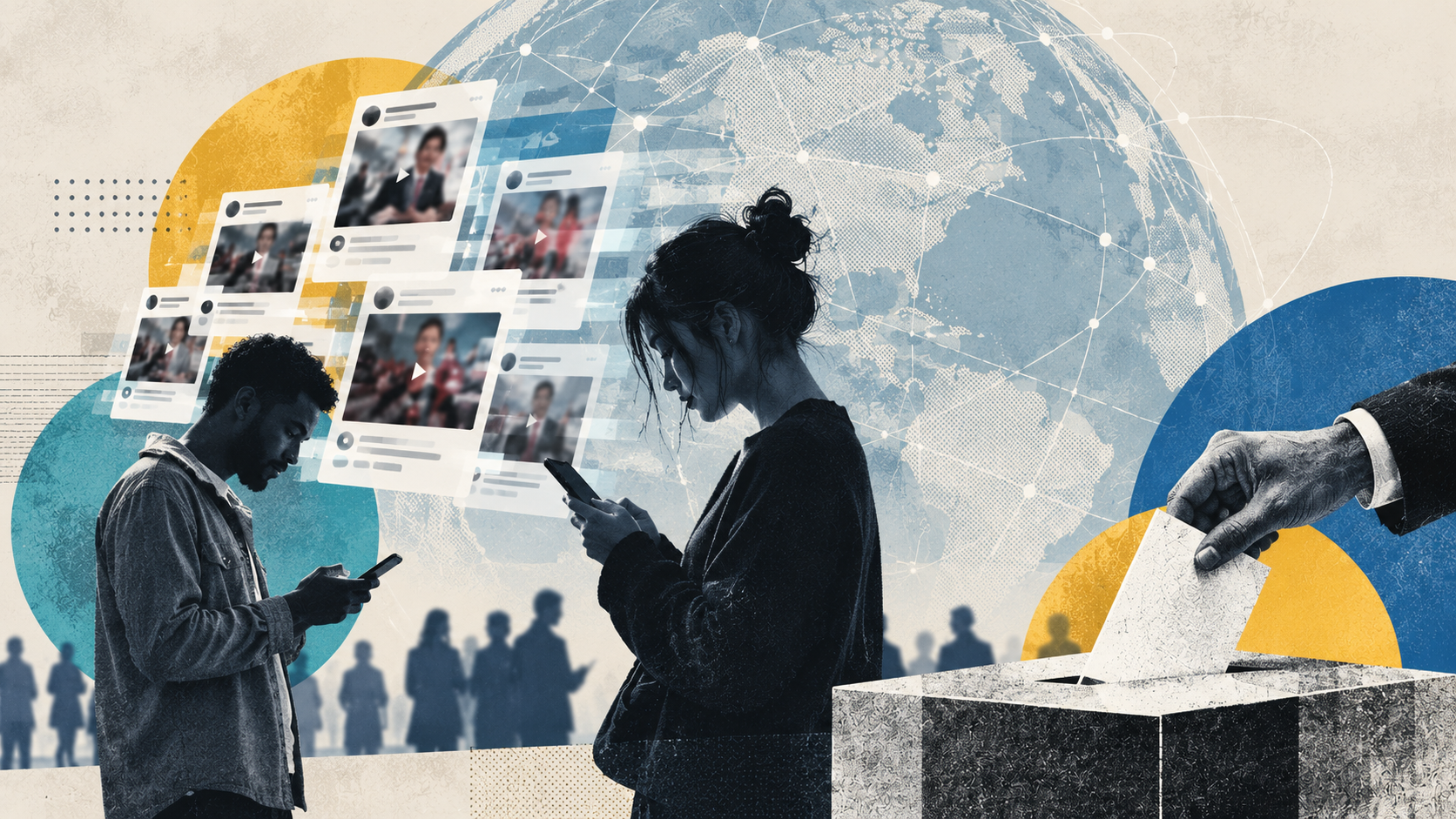
Some of the highest-impact societal risks posed by advanced AI systems are those that undermine and destabilize our societal institutions. A trio of factors—growing populism and authoritarianism around the world, social media as the primary information source for a majority of voters, and powerful, cheap and easy AI tools at our fingertips—has created perfect conditions for election interference and other forms of systemic destabilization. Recent research led by experts in the field, including CIFAR researchers, examines how the rapid development of advanced AI systems poses a significant threat to democracy and how we can respond.
Deepfakes in the 2025 Canadian Election: Prevalence, Partisanship, and Platform Dynamics — Livernoche et al., 2026.
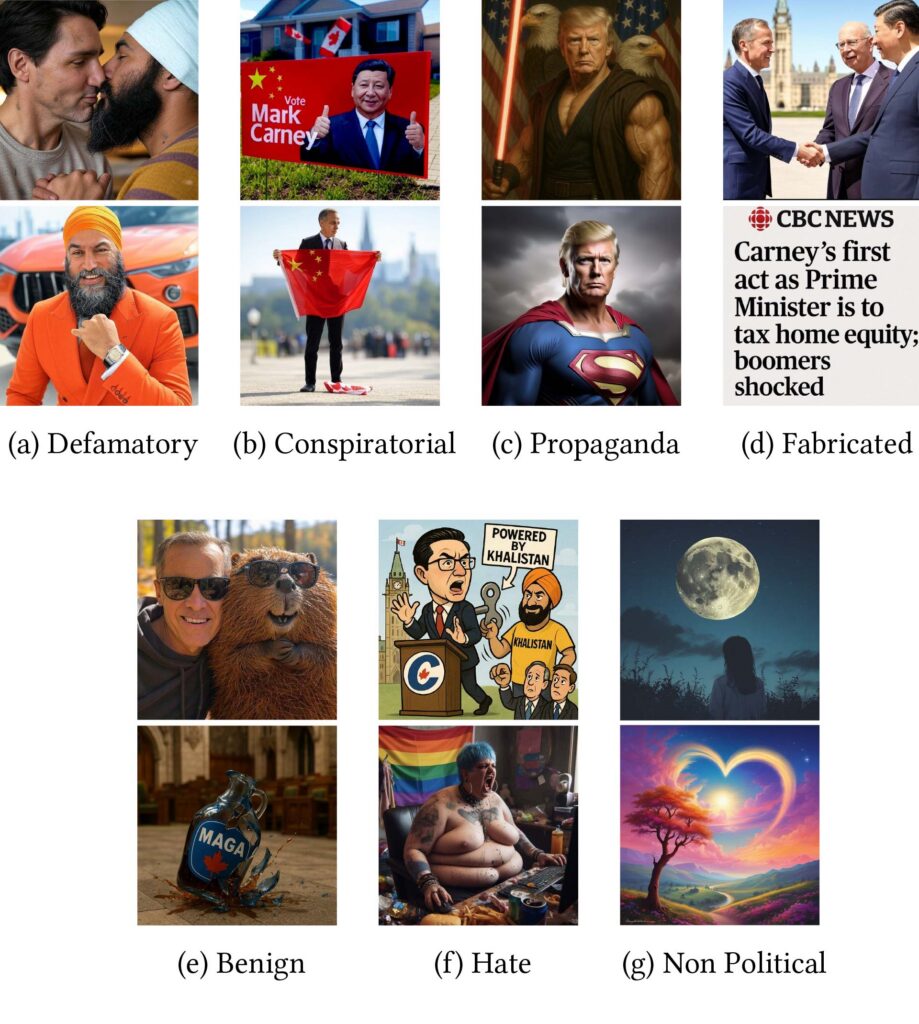
This research out of McGill University, led by Professor Reihaneh Rabbany (Canada CIFAR AI Chair at Mila and a Research Council Member of the CAISI Research Program at CIFAR) looked at the volume and impact of AI-generated synthetic content in the 2025 Canadian Election. In many ways, the results were reassuring; the authors analyzed more than 185,000 posts on major social media platforms and found that around 6 per cent were deepfakes, but that these were mostly innocuous. Those that were potentially harmful (see real examples of images intended to be defamatory, conspiratorial, propagandistic, and hateful below) got very little traction, with only 0.1per cent of total views for these potentially politically harmful deepfakes. The authors note that highly realistic fabricated images pose a special challenge, as they appear sufficiently credible to be mistaken for authentic. This year’s International AI Safety Report (Bengio et al., 2026) posits that one of the most significant advances in frontier model technology over the last year has been the increased realism of deepfake images. While the prevalence of these images was low in the 2025 Canadian election, this category of image represents an important risk that needs to be taken seriously in the future, particularly as the prevalence of convincing deepfakes continue to grow.
AI in the Ballot Box — Four Actions to Safeguard Election Integrity and Uphold Democracy — Régis et al., 2025.
So how can we respond to these threats? In a highly accessible and widely disseminated whitepaper, Professor Catherine Régis and colleagues emphasize four steps that governments should adopt to mitigate the negative impact of advanced AI systems in elections or referenda:
- Update election rules to prohibit the use of AI-generated or disseminated content in misleading ways — from banning malicious deepfakes to prohibiting the spread of intentional misinformation to labelling synthetic content.
- Political parties should engage in and take responsibility for the risks to our democracies in the age of AI — parties should commit to advancing responsible AI use and AI literacy for campaign staff.
- Create an AI and cybersecurity response team within electoral authorities — to help monitor and counter malicious AI use both within and outside the election period.
- Work internationally, share best practices and insights — create a trusted network of nations working together to identify and combat AI misuse.
These recommendations provide clear, actionable steps that governments at every level can consider as they work to update their policies and technical responses to protect democracy in the age of AI. Already, these insights seem to be gaining traction in Canada, with various political parties actively seeking additional information about what they can do, and the Government of Canada tabling new legislation on March 26, 2026 to update the Canada Elections Act, including banning deepfakes and countering disinformation in federal election processes. But, as Tenove, Tworek and Mckay (2026) argue in other recent CIFAR-supported work, individual policies alone will be insufficient to fully address and mitigate the potential harms of generative AI in democratic elections.
AI Poses Risks to Democratic and Social Systems — Piedrahita et al, 2026.
The threat to democratic institutions posed by AI goes beyond elections, with the potential to impact critical social systems more broadly. A new whitepaper by an international research team led by Professor Zhijing Jin at the University of Toronto (Canada CIFAR AI Chair, Vector Institute) provides an important complement to the International AI Safety Report, going beyond discrete risks posed by advanced AI systems to look more systemically. The authors argue that advanced AI poses sociopolitical risks, where the harms may only be detectable in the aggregate. These risks are pernicious because they may already have been deployed widely before their impact is understood. The authors identify seven failure modes where advanced AI systems can harm our social systems:
- Belief homogenization — Modern LLMs are inherently designed to provide a narrow range of outputs, in line with the most prevalent data they are trained on; where LLMs are widely used to deliver information to citizens, the range and diversity of perspectives is reduced compared to the full spectrum of human perspective.
- Belief reinforcement — AI assistants create powerful reinforcement loops that are optimized to user satisfaction and platform incentives, driving entrenchment of ideas. This is in direct conflict with the freedom to revise one’s position that is inherent in modern democracy.
- Congested bureaucracy — Cheap, AI-generated civic submissions can overwhelm the bureaucracy, requiring gating mechanisms that can impact engagement.
- Epistemic flood — When plausible political content overwhelms our ability to verify or respond to it, it’s hard to know what is true.
- Unauditable authority — The AI “black box” makes it difficult for governments to oversee corporate conduct and for civil society to oversee government.
- Normative centralization — Commercial AI products contain inherent normative constraints that may not align with those of the society where they are being deployed.
- Power concentration — Control over advanced models, infrastructure and deployment pipelines is increasingly concentrated in a few large companies; their power and control is amplified as AI systems become more capable and widely adopted.
For each of these systemic failure modes, the authors propose policy recommendations to mitigate or counteract the threat. Furthermore, their analysis provides important directions for future research and policymaking, emphasizing the need to go beyond the current focus of the international community on the understanding of model (mis)alignment to also invest in understanding the broader, more pervasive societal impacts of advanced AI systems.
What It Means
One of the key takeaways from this year’s International AI Safety Report update (Bengio et al., 2026) is that societal resilience will be essential for managing AI-related harms. The most obvious risks to our social and democratic systems from advanced AI systems are the dissemination of malicious synthetic content and AI-driven persuasion/manipulation for political means. As a society, we need to invest more strategically and significantly in mitigating those risks with a suite of complementary mechanisms, including systematic AI literacy and public engagement efforts, legislation and regulations to penalize malicious actors, and continued research on the development of tools and techniques for the identification and labelling of malicious content.
These three recent publications underline how CIFAR researchers are at the forefront of advancing research and collaborating internationally to advance our understanding of how to mitigate the risks of AI on our democratic systems. Given the current geopolitical context, it’s absolutely critical that Canada remains an engaged global leader in advancing this work. Mitigating the risks of synthetic content is a priority focus for the Canadian AI Safety Institute Research Program at CIFAR, with projects working to tackle a variety of risks, from detecting misinformation and foreign interference to mitigating the impact of AI-generated evidence in our justice system. Building off the understanding that Canadian researchers are developing around the impact of advanced AI systems on the integrity of our democratic institutions, we continue to support research on both technical and sociotechnical approaches to mitigate this risk.
References
- Bengio, Yoshua; Clare, Stephen; Prunkl, Carina; Murray, Malcolm; Andriushchenko, Maksym; Bucknall, Ben, et al. (2026). International AI Safety Report 2026. UK Department for Science, Innovation and Technology. https://internationalaisafetyreport.org.
- Livernoche, Victor; Musulan, Andreea; Yang, Zachary; Godbout, Jean-François; Rabbany, Reihaneh. (2026). Deepfakes in the 2025 Canadian Election: Prevalence, Partisanship, and Platform Dynamics. ACM Web Conference 2026 (WWW ’26). https://doi.org/10.1145/3774904.3792948
- Piedrahita, David Guzman; Banerjee, Dave; Blin, Kevin; Cobben, Pepijn; Corsi, Giulio; Huang, Xuanqiang Angelo; et al. (2026). AI Poses Risks to Democratic and Social Systems. [White paper]. https://zhijing-jin.com/d/2026-ai-risk.pdf
- Régis, Catherine; Martin-Bariteau, Florian; Effoduh, Okechukwu (Jake); Gutiérrez, Juan David; Neff, Gina; Souza, Carlos Affonso; et al. (2025). AI in the Ballot Box: Four Actions to Safeguard Election Integrity and Uphold Democracy. [White paper]. IVADO. https://ivado.ca/en/repertoire-des-ressources/ai-in-the-ballot-box/
- Tenove, Chris; Tworek, Heidi; McKay, Spencer (2026). Canadian Policy Responses to Artificial Intelligence-Generated Threats to Democratic Elections. Canadian Public Policy/Analyse de Politiques 52(S1), 109-121. https://utppublishing.com/doi/10.3138/cpp.2025-042